
Tennessee Uses Circuit Court for General Jurisdiction
Tennessee places general-jurisdiction trial-court authority in the Circuit Court rather than in a "District Court" or "Superior Court." The Tennessee Administrative Office of the Courts describes Circuit Courts as courts that hear civil and criminal cases and also hear appeals from Juvenile, Municipal, and General Sessions Courts. That appellate role inside the trial-court tier is important: a case that started in General Sessions as a misdemeanor or a small civil suit can end up before a Circuit Court judge on appeal without ever going to the Court of Appeals.
Shelby County sits in the 30th Judicial District. The county is large enough to have separate, legislatively created courts for criminal matters and equity, so the Circuit Court here does not carry the full load it might in a smaller county. Circuit Court in Shelby County concentrates on civil and domestic matters: personal injury, contract disputes, divorce, name changes, appeals from lower courts, and related filings. Felony criminal cases run through the separate Criminal Court. Equity matters go to Chancery Court. Each court has its own clerk and its own records system.
That split is worth understanding before you search. If you want a Shelby County Circuit Court record, you go to the Circuit Court Clerk at 140 Adams Avenue, Room 324. If you want a criminal case record, that is the Criminal Court Clerk at 201 Poplar Avenue, Suite 3034. The right clerk matters because no single online portal covers all of Shelby County's courts at once.
The Shelby County Trial Court Hierarchy
Tennessee's court ladder has four main levels for most cases. At the top is the Tennessee Supreme Court, which takes only those cases it chooses to review and also handles attorney discipline and court administration. Below that sit two intermediate appellate courts: the Tennessee Court of Appeals for civil matters, and the Tennessee Court of Criminal Appeals for criminal matters. Both are statewide courts that travel across Tennessee and are not physically based in Shelby County.
The trial-court level is where cases begin and where evidence is heard. Shelby County has more trial courts than most Tennessee counties because its population and caseload require them. Circuit Court is the anchor for general civil jurisdiction. Chancery Court handles equity. The separately established Criminal Court hears felony and state criminal matters. Probate Court exists as a distinct court for estates, guardianships, name changes, and related matters. Below all of those are General Sessions, Juvenile Court, and Municipal Courts, which have limited jurisdiction and feed cases upward when the charge or claim exceeds their authority.
The case flow below shows the main path a case takes through this structure. Not every case goes all the way up. Many resolve at General Sessions or Circuit Court. The path depends on case type, outcome, and whether either party appeals.
Case Flow: General Sessions or Juvenile Court → Circuit Court / Chancery Court / Criminal Court → Court of Appeals (civil) or Court of Criminal Appeals (criminal) → Tennessee Supreme Court.
Note: A case moving from General Sessions to Circuit Court is called a bound-over (criminal) or an appeal (civil). The Circuit Court then hears the matter fresh or on the record from below, depending on the type of appeal.
Shelby County Courts and Locations
Shelby County's courts are spread across a compact section of downtown Memphis. The civil courts cluster at 140 Adams Avenue, officially known as the Judge D'Army Bailey Courthouse. Criminal courts are at 201 Poplar Avenue, the Walter L. Bailey Criminal Justice Center. Juvenile Court has its own building at 616 Adams Avenue. All three addresses are within a few blocks of each other, but arriving at the wrong building wastes time, so confirm your court before you go.
The table below lists each court or clerk office with its address, phone number, and key notes. Hours for most offices are Monday through Friday, 8:00 a.m. to 4:30 p.m., unless noted otherwise.
| Court / Office | Address | Phone | Notes |
|---|---|---|---|
| Circuit Court / Circuit Court Clerk | 140 Adams Ave., Room 324, Memphis, TN 38103 | (901) 222-3800 | Nine judges/divisions; about 5,500 cases annually; fax (901) 222-3818. |
| Chancery Court / Clerk and Master | 140 Adams Ave., Room 308, Memphis, TN 38103 | (901) 222-3900 | Equity, tax sales, divorces, mandamus, public nuisance, replevin; fax (901) 222-3909. |
| Probate Court / Probate Court Clerk | 140 Adams Ave., Room 124, Memphis, TN 38103 | (901) 222-3750 | Conservatorships, guardianships, wills, estates, name changes, birth-certificate corrections, judicial hospitalization; fax (901) 222-3756. |
| Criminal Court / Criminal Court Clerk | 201 Poplar Ave., Suite 3034, Memphis, TN 38103 | (901) 222-3200 | Felony criminal cases and payments; CJS portal referenced for case lookup. |
| General Sessions Civil Division | 140 Adams Ave., Room 106, Memphis, TN 38103 | 901-222-3400 | Civil suits, detainers, interpleaders, civil calendars online. |
| General Sessions Criminal Division | 201 Poplar, Suite LL-81, Memphis, TN 38103 | 901-222-3500 | Misdemeanors, preliminary hearings, traffic tickets. |
| Juvenile Court Clerk | 616 Adams Ave., Memphis, TN 38103 | (901) 222-0600 | Juvenile records, expungements, warrants, summons, petitions, motions, appeals; restricted public access. |
General Sessions also has satellite offices: 1075 Mullins Station Road, Room W115 (901-222-7900) and 1254 East Shelby Drive, Suite 270, Southbrook Mall (901-222-3665), both open Monday through Friday, 8:00 a.m. to 4:15 p.m. Those offices handle General Sessions matters for east and south Memphis residents who want to avoid a downtown trip.
Lower Courts: General Sessions, Juvenile, and Municipal
Below Circuit Court in the Tennessee hierarchy sit three categories of limited-jurisdiction courts. Each has a defined scope. Cases that go beyond that scope move up to Circuit Court, Criminal Court, or Chancery Court.
The General Sessions Court in Shelby County is split into a Civil Division and a Criminal Division. The Civil Division handles smaller civil suits, detainers, and interpleaders. The Criminal Division takes misdemeanor charges, preliminary hearings, traffic citations, and bound-over proceedings before cases move to Criminal Court. General Sessions has additional divisions aligned with specialty programs, which are covered in the specialty courts section below. The General Sessions Court Clerk is Tamara A. Sawyer. Civil case calendars are available at the General Sessions site; criminal court dates link to the Criminal Justice System portal.
The official Juvenile Court sits at 616 Adams Avenue and is led by Clerk Janeen R. Gordon. Juvenile Court handles youth delinquency, dependency, child support, custody, and related statutory matters. Records are restricted under Tennessee juvenile law. Public access is not the same as for adult courts. The Juvenile Court Clerk publishes separate contact emails for records requests, expungements, warrants, appeals, and emergent matters. Do not expect to walk in and pull a juvenile file the way you would a Circuit Court civil record.
Municipal Courts operate at the city level and handle city ordinance violations and local traffic matters. Memphis and other incorporated cities in Shelby County may have their own municipal-court operations. Municipal Court decisions can be appealed up to General Sessions or Circuit Court depending on the matter.
The official General Sessions Criminal Court page links an online case-review tool and includes a disclaimer about the accuracy of online database information. Read that disclaimer before relying on an online status for any official purpose.
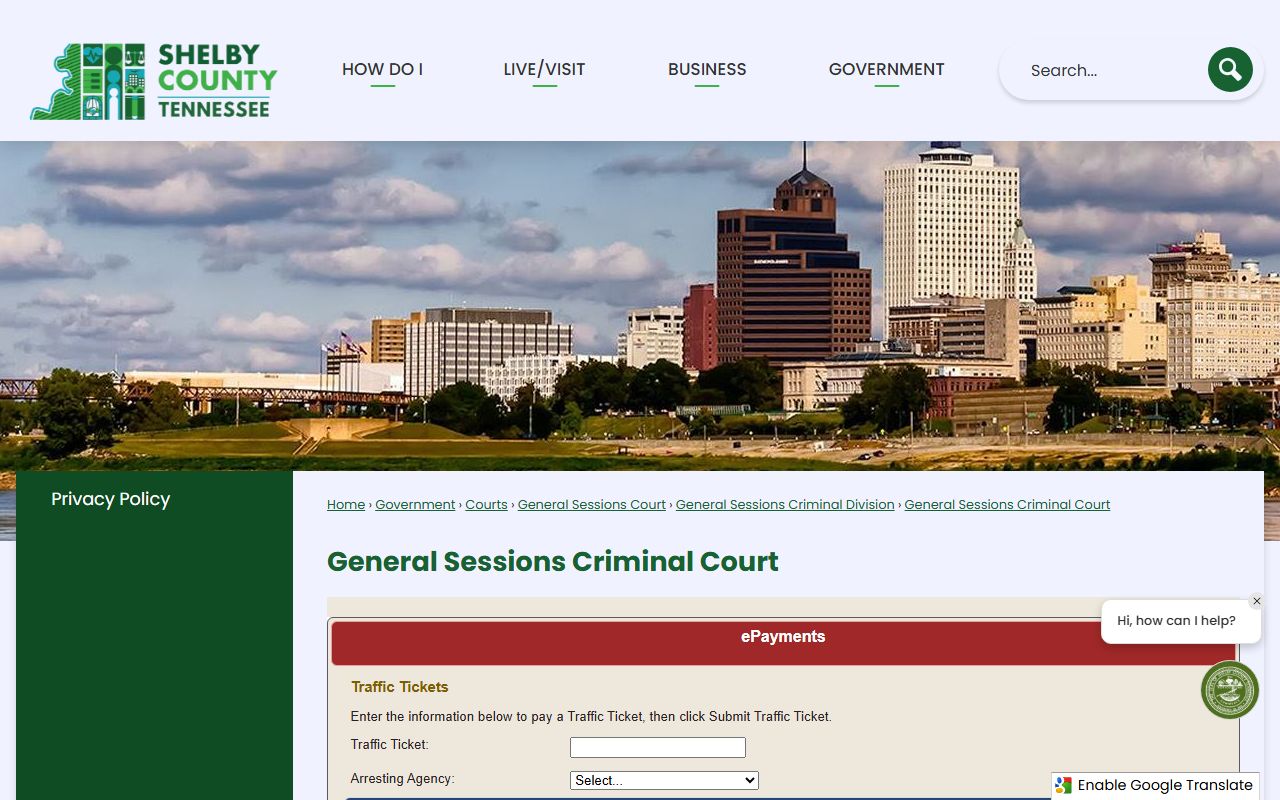
The General Sessions Criminal Court page is the starting point for misdemeanor case information and links to the online case-review system used by Shelby County's lower criminal courts.
Circuit Court vs General Sessions Court
People often wonder which court handles their matter. The short answer is that General Sessions is limited and Circuit Court is broader. If a General Sessions judge decides the matter is beyond the court's authority, it moves up. If either side appeals a General Sessions outcome, Circuit Court hears it again. The comparison below covers the main differences.
| Point | Circuit Court | General Sessions Court |
|---|---|---|
| Jurisdiction type | General jurisdiction | Limited jurisdiction |
| Civil matters | Injury, contract, name change, personal injury, worker's compensation, wrongful death | Smaller civil suits, detainers, interpleaders within statutory dollar limits |
| Criminal matters | Appeals from lower courts; certain criminal appeals | Misdemeanors, preliminary hearings, traffic citations |
| Divorce | Yes, with or without minor children | No |
| Appeal from this court | Court of Appeals (civil) or Court of Criminal Appeals (criminal) | Circuit Court |
| Record holder | Circuit Court Clerk, Jamita E. Swearengen | General Sessions Court Clerk, Tamara A. Sawyer |
| Divisions | Nine judges/divisions, about 5,500 cases per year | Multiple civil and criminal divisions, including specialty divisions |
If you are unsure which court holds your case, search both records systems. A case bound over from General Sessions to Criminal Court leaves a record in both places. The same is true for a civil matter appealed from General Sessions to Circuit Court.
For Shelby County court records of any type, start by matching the case to the right court using the table above. Then contact the correct clerk or use the official portal for that court.
The Appeals Path from Shelby County Courts
Appeals from Shelby County trial courts go to one of two intermediate courts, depending on the case type. Civil appeals go to the Tennessee Court of Appeals. Criminal appeals go to the Tennessee Court of Criminal Appeals. Both courts are statewide panels; they do not sit permanently in Memphis but do hear cases from the western district. After the intermediate court rules, a party may ask the Tennessee Supreme Court to take the case. The Supreme Court has discretion to decline.
The Tennessee Supreme Court also sets rules for all Tennessee courts, handles attorney discipline through the Board of Professional Responsibility, and administers the unified state court system through the Administrative Office of the Courts. The Tennessee AOC court-structure page explains the relationship between Circuit, Chancery, and Criminal Courts and the appellate layer above them.
One point worth noting: General Sessions appeals go to Circuit Court, not directly to the Court of Appeals. So a losing party in General Sessions takes a second swing at the Circuit Court level before reaching the state appellate courts. That makes Circuit Court both a trial court for original matters and an appellate court for General Sessions and Municipal Court decisions. It is a dual role that most trial courts in other states do not have.
Specialty Courts: Veterans, Mental Health, Domestic Violence
Shelby County operates several specialty court programs that divert eligible participants from the standard criminal track. These courts sit within the General Sessions and Criminal Court divisions but apply a different approach: supervised treatment, monitoring, and community support instead of standard prosecution. Three programs are active and publicly documented.
Veterans Court is the oldest and best-known of the three. The official Veterans Court page says Shelby County was the first court in Tennessee to launch a Veterans Court program. The program diverts eligible military veterans charged with criminal offenses who have substance dependency, serious mental health issues, or other conditions that respond to treatment. Participants commit to sobriety, mental-health work, and law-abiding behavior under judicial supervision. The presiding judge is the Honorable Christian Johnson, and the court operates on the lower floor of 201 Poplar Avenue in Division 15. Entry requires consent of the prosecutor, defense counsel, the defendant, the referring judge, and the Veterans Court judge unless the participant was sentenced directly to the program.
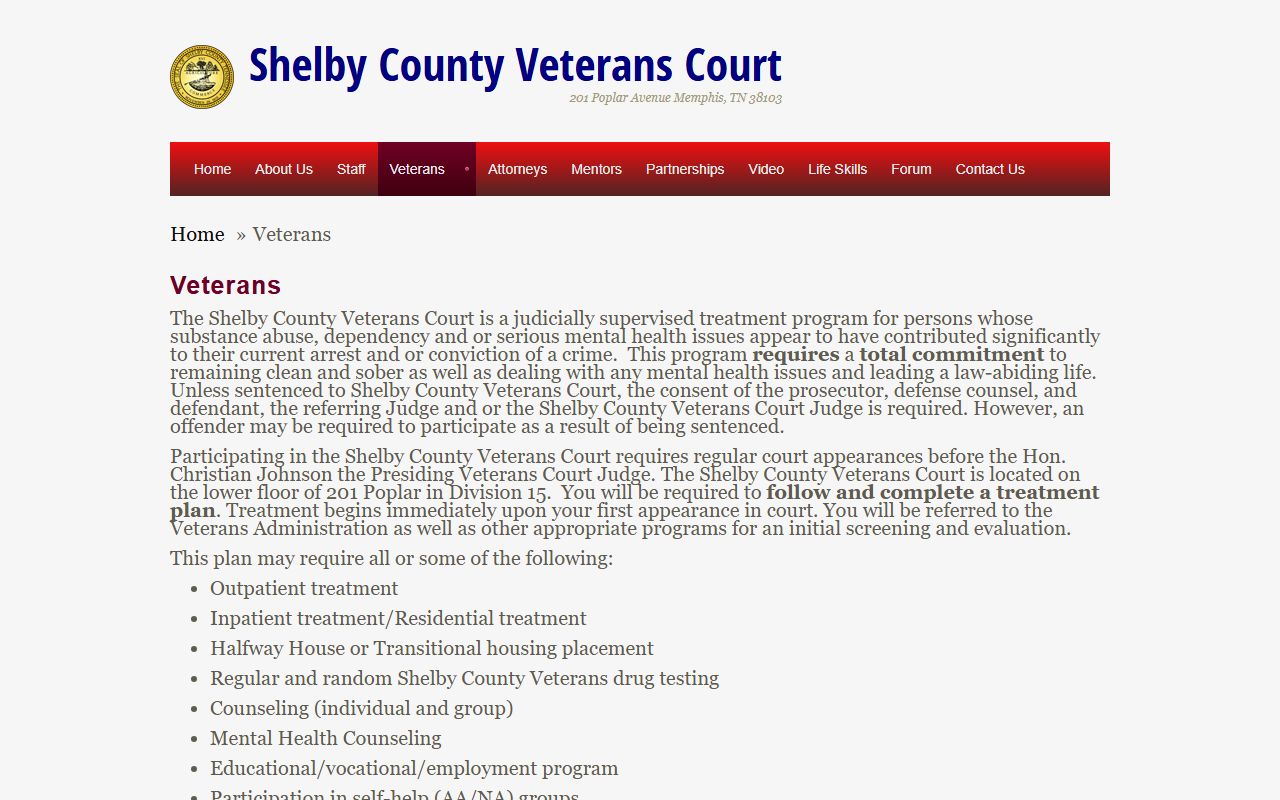
The official Veterans Court page describes eligibility requirements, the judicial supervision model, and how Shelby County's first-in-Tennessee program serves veteran participants at 201 Poplar.
Mental Health Court operates within General Sessions Division 9. The District Attorney's vertical-prosecution structure pairs General Sessions Division 9 with Criminal Court Division 2 in a team focused on mental-health cases. A Shelby County mental-health mapping report identifies Mental Health Court as a General Sessions Criminal Court program running both pre- and post-adjudication phases. The program connects participants with behavioral-health treatment as part of their court supervision.
Domestic Violence Court is handled by the DA's Domestic Violence Unit, which by law has exclusive jurisdiction over all domestic violence cases through General Sessions Court Division 10 and Criminal Court Division 5. The unit covers domestic assault and intimate-partner homicide and works with community organizations including the Family Safety Center, Kindred Place, and the YWCA. Cases that begin in General Sessions Division 10 can move to Criminal Court Division 5 as the case progresses.
Shelby County also has a drug treatment court component embedded in the specialty-court structure. The Veterans Court program uses drug-treatment-court ten key components as adapted for veteran participants. The DA's vertical teams include teams aligned with the specialty dockets, ensuring prosecutors track cases from General Sessions through Criminal Court for each specialty program.
The Federal District Court Is Separate
The U.S. District Court for the Western District of Tennessee is not part of the Tennessee state court system. It is a federal court with its own clerk, its own records system, and its own appeals path. State court cases do not move to federal court through normal appeal. Federal cases arise from federal law, federal constitutional questions, diversity of citizenship between parties from different states, or specific federal subject-matter grants.
The Memphis courthouse for the Western District is located at the Odell Horton Federal Building, 167 North Main Street, Memphis, TN 38103, phone (901) 495-1200, hours 8:30 a.m. to 4:30 p.m. CST. The court has jurisdiction over federal cases arising in 22 counties in western Tennessee. That footprint includes Shelby County and a large portion of the state to the north and south along the Mississippi corridor.
The official Western District of Tennessee court site is the starting point for federal case information in Memphis. The site links to PACER for case access and to CM/ECF for electronic filing by attorneys. Federal appeals from the Western District go to the U.S. Court of Appeals for the Sixth Circuit, not to the Tennessee Court of Appeals. Specialized federal cases involving patents or international trade go to the Federal Circuit, a separate route.
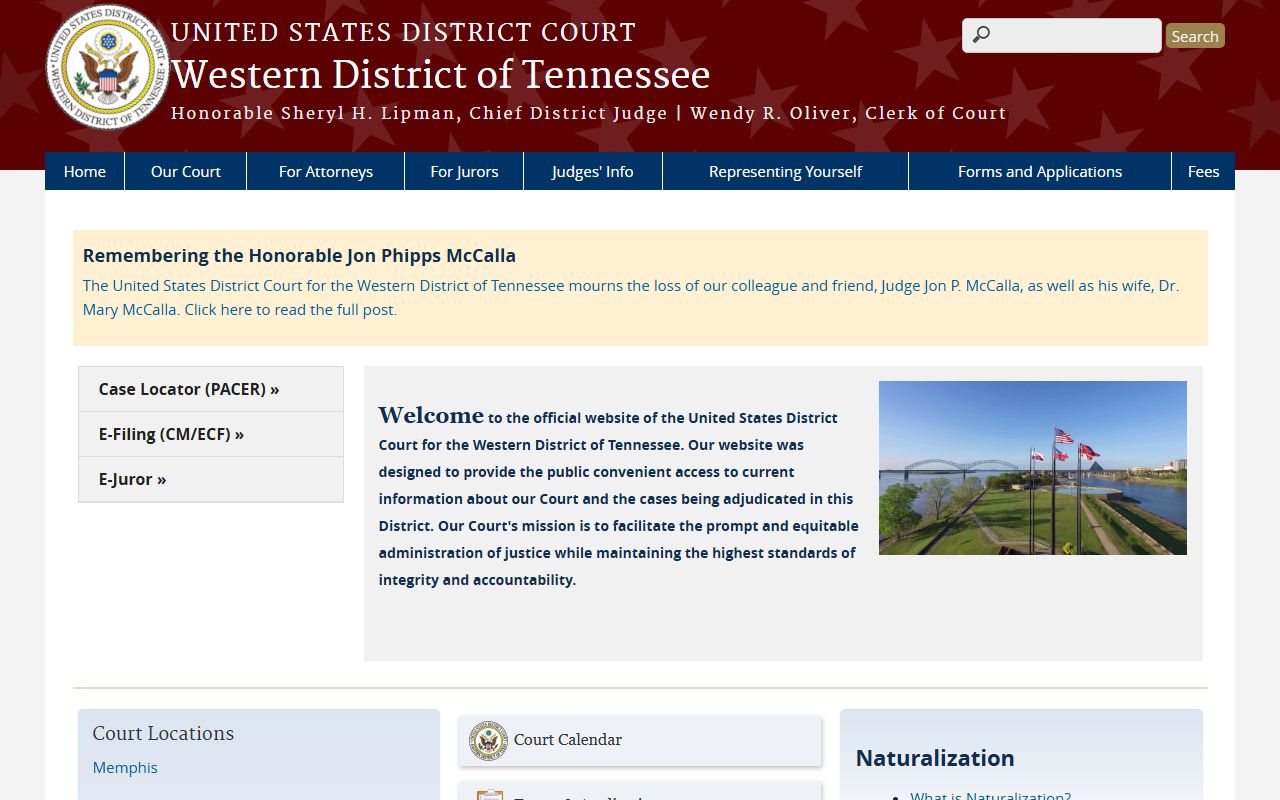
The Western District of Tennessee federal court homepage lists Memphis courthouse information, hours, and links to the case access and filing systems used for federal matters in Shelby County.
Federal bankruptcy cases in Shelby County are handled by the U.S. Bankruptcy Court for the Western District of Tennessee, a separate Article I court. The Western District Bankruptcy Court has its own clerk and records system. Federal criminal prosecutions are brought by the U.S. Attorney's Office for the Western District of Tennessee, located at 167 North Main Street, Suite 800, Memphis, TN 38103, phone (901) 544-4231.
The U.S. Court of Appeals for the Sixth Circuit hears appeals from the Western District of Tennessee along with appeals from federal courts in Michigan, Ohio, and Kentucky. Opinions from the Sixth Circuit are binding precedent in federal courts throughout those states.
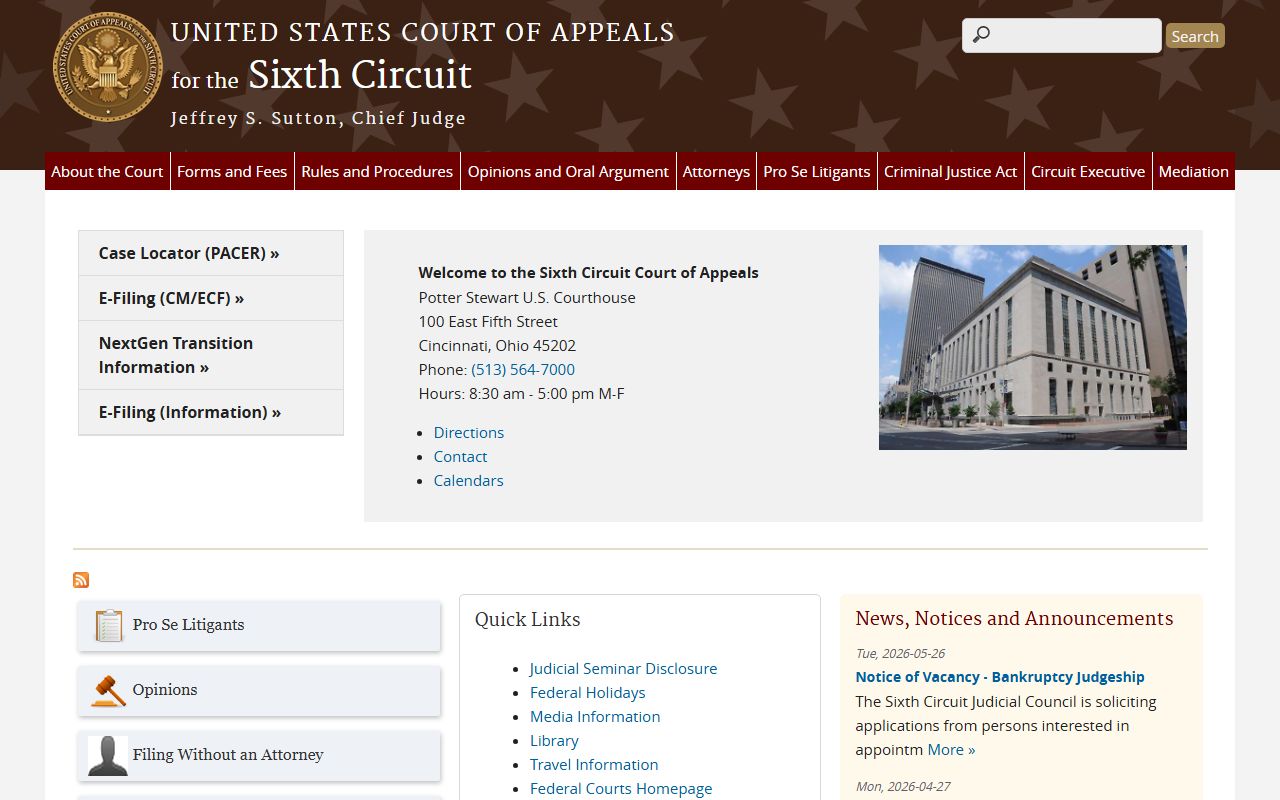
The Sixth Circuit Court of Appeals handles federal appeals from the Western District of Tennessee, serving as the intermediate federal appellate court for Shelby County cases that go beyond the district court level.
Accessing Federal Case Records Through PACER
Federal court records are not available through the Tennessee AOC or through Shelby County's local court portals. They are accessed through PACER, which stands for Public Access to Court Electronic Records. PACER is a fee-based federal system that covers district courts, courts of appeals, and bankruptcy courts across the country. Registration is free; access to documents costs a per-page fee, though accounts with charges under $30 per quarter are often waived.
The PACER registration and access site is the official starting point. Once you have an account, you can search by party name, case number, or attorney name across any participating federal court including the Western District of Tennessee. The Western District also links its own PACER Case Locator from its homepage for quick lookups without navigating the full PACER interface.
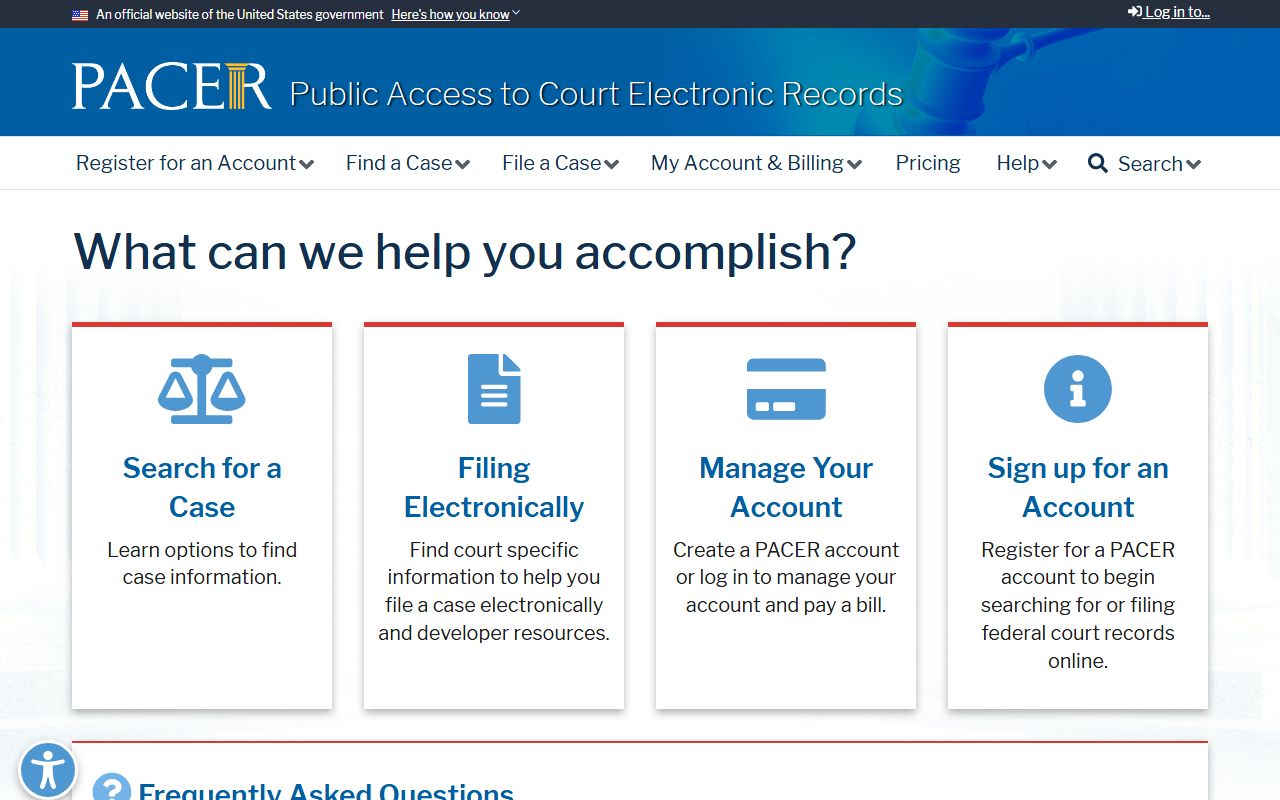
PACER is the official access point for all federal court records, including Western District of Tennessee cases involving Shelby County parties, and requires a registered account to view documents beyond basic docket entries.
CourtListener is a free non-official alternative that covers many federal opinions and some docket information, but it is not the official record and may not have current case status or sealed materials. For anything requiring certified federal court records, contact the Western District Clerk's Office directly at (901) 495-1200.
Note: PACER does not include state court records. Shelby County state court records are held by the individual court clerks and accessed through the portals described in the Shelby County court records section.
How a Case Moves Through the System
Most Shelby County cases start at the lowest court with jurisdiction over them and move up only if something pushes them there. A traffic ticket or misdemeanor starts in General Sessions Criminal. A civil suit for a modest amount starts in General Sessions Civil. A felony charge may start in General Sessions as a preliminary hearing but then go to Criminal Court when the case is bound over after probable cause is found. A civil divorce or personal injury case goes straight to Circuit Court or Chancery Court depending on its nature.
Once in the trial court, the case moves through a set of standard steps. In a civil case: a complaint is filed, summons issued, defendant served, answers and motions exchanged, discovery conducted, a hearing or trial held, and a final order or judgment entered. In a criminal case: the arrest, booking, bond hearing, preliminary hearing, indictment or information, arraignment, plea or trial, sentencing, and post-judgment proceedings follow in order. Docket entries in the clerk's file record each of these events with a date and event type. Those docket entries are what you see when you look up a case in Shelby County court dockets.
After a final judgment, either side can appeal. Civil cases go to the Tennessee Court of Appeals; criminal cases go to the Tennessee Court of Criminal Appeals. The appellate court reviews the trial record rather than holding a new trial. If the appellate court reverses, the case may go back to the trial court for further proceedings. The Tennessee Supreme Court sits at the top and takes only the cases it selects through its discretionary review process. Only a small fraction of Shelby County cases ever reach that level.
- Case filed in the lowest court with jurisdiction: General Sessions, Circuit, Chancery, Criminal, Probate, or Juvenile.
- Preliminary steps: summons, service, bond hearing, or preliminary hearing depending on case type.
- Motions and discovery phase; hearings set and held; orders entered.
- Trial, plea, or final hearing; judgment or sentence entered; docket closed or kept open for post-judgment matters.
- Appeal (if any) filed in Court of Appeals or Court of Criminal Appeals within the statutory deadline.
- Appellate court reviews the record and issues a written opinion; affirms, reverses, or remands.
- Tennessee Supreme Court discretionary review (rare); or the opinion of the intermediate court becomes final.
For criminal records in Shelby County, the Criminal Court Clerk and the General Sessions Criminal Division are the two main offices. A case that touched both courts will have records in both places. Always check the court that handled the most recent proceeding, since that is where the current docket entries and any post-judgment orders will be.
Juvenile Court Access and Records
Juvenile Court is worth a separate note because its records work differently from every other court on this page. The Juvenile Court Clerk at 616 Adams Avenue manages records that are restricted under Tennessee juvenile statutes. T.C.A. § 37-1-153 governs juvenile record confidentiality and expunction. Public access to juvenile files is not a right in the same way it is for Circuit Court civil files. Many juvenile records are sealed by default or restricted to parties and their attorneys.
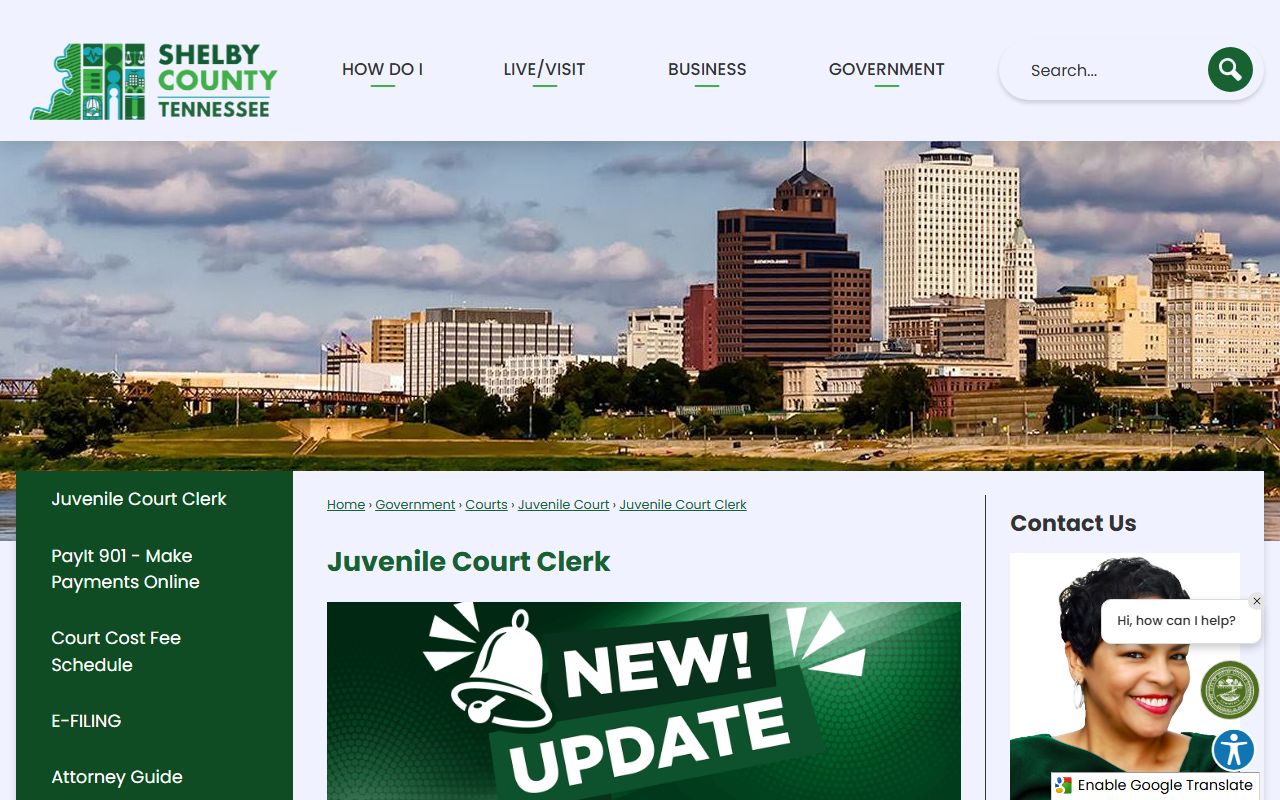
The Juvenile Court Clerk page lists separate contact addresses for records requests, expungements, court dates, and emergency matters, reflecting the restricted and specialized nature of Juvenile Court access in Shelby County.
If you need a juvenile record or have a pending expungement matter, use the Juvenile Court Clerk's published contact emails for the specific topic rather than calling the main line. The Clerk's page lists topic-specific email addresses for records requests, expungements, court appearance questions, warrant or summons matters, petitions or motions, appeals, and general questions. That routing system speeds up responses. The main office number is (901) 222-0600.
Juvenile Court also handles child support enforcement, dependency and neglect, and custody matters when those cases arise under the juvenile statutory framework. Some custody and support matters may overlap with Circuit Court filings. If you are not sure which court holds a family matter, contact both clerks to confirm where the active file lives.