
How to Find Shelby County Arrest Records
Arrest records in Shelby County start when the Sheriff's Office or a local law enforcement agency books a person into the jail. The primary tool for recent bookings is the Shelby County Inmate Lookup Tool, which is free and open to the public. A search there shows who is currently in custody and, if you check the released-inmates box, who has been recently released. Booking dates, bond information, and detainer details all appear on the profile.
For cases that moved past booking into the court system, the Criminal Justice System (CJS) portal is the county's main criminal case database. The official Criminal Court page says users must register and sign in to search case information there. General Sessions Criminal also links to CJS for court-date lookups. So the two-step path for most arrest records searches is: start with the jail roster to confirm a booking, then check CJS or contact the Criminal Court Clerk for court file details.
The Shelby County Sheriff's Office site is the main entry point for both jail information and the warrant search. Sheriff Floyd Bonner, Jr. oversees jail operations. The men's facility sits at 201 Poplar Avenue in downtown Memphis, while the women's facility is at 6201 Haley Road in east Memphis.
- Go to the Shelby County Inmate Lookup Tool and search by first name, last name, and date of birth. You can also search by Booking Number, Permanent Number, or State ID if you have one of those identifiers.
- Check the "Include released inmates" box if the person may have been released recently. Results show a Release Date column so you can see when they left custody.
- Click on a result row to open the full profile. Review booking number, commitment date, bond information, detainer details, and any hearing information listed.
- If charges moved to Criminal Court, go to the CJS portal. Register or log in, then use Smart Search or the case number (eight characters, a dash, then eight more) to locate the court file.
- For certified copies or records not accessible online, contact the Criminal Court Clerk's Office at 201 Poplar Avenue, Suite 3034, Memphis, TN 38103, phone (901) 222-3200, Monday through Friday 8:00 a.m. to 4:30 p.m.
Note: The CJS portal was blocked by Cloudflare during the May 26, 2026 research pass for this site. If the portal is unavailable, call the Criminal Court Clerk for help finding a case.
CJS Portal and Payments
The Criminal Justice System portal at cjs.shelbycountytn.gov/CJS is the main online database for Shelby County criminal court cases. Registration and sign-in are required to search case information. The table below shows the fields the portal uses, based on the official Criminal Court page instructions.
The Shelby County Criminal Court page explains how online payments also route through CJS, using the payit901 service for Criminal Court cases.
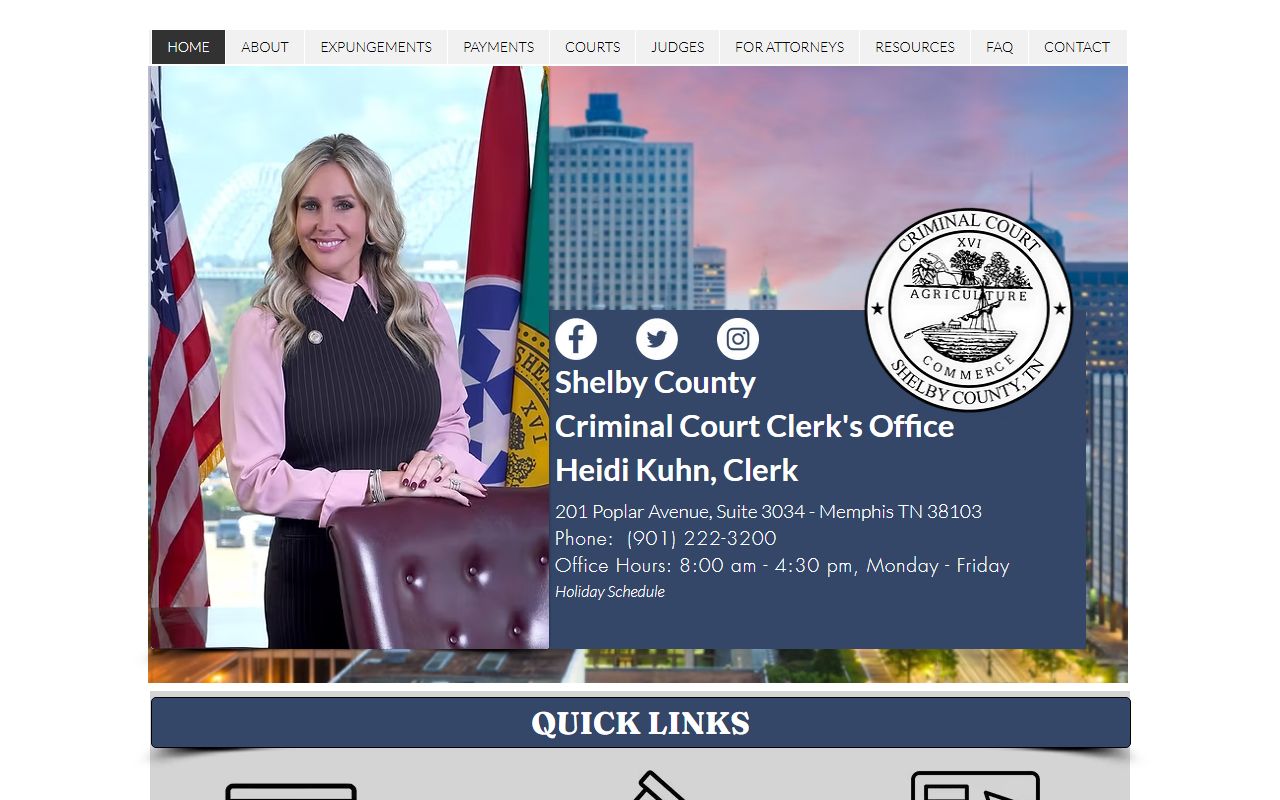
The Criminal Court page lays out the payment and case-search instructions, including how case numbers are formatted and when to use a booking number instead.
| Field Label | Type | Required | Notes / Format |
|---|---|---|---|
| Login / registration | Gated | Yes for full search | Must register and sign in to search case information. |
| Smart Search | Search tool | Varies | Used to find a case to view or pay online. |
| Case number | Text | Optional | Format is 8 characters, dash, 8 characters. If it starts with C, enter the case number directly. |
| Indictment number | Text | Conditional | Use if the case number does not start with C. |
| Booking number | Text | Conditional | Enter with the indictment number when no C-prefix case number is available. |
Online payment for Criminal Court cases uses payit901. If the case number starts with C, enter it directly. If not, enter the indictment number and booking number together. If you do not know both numbers, use the CJS Smart Search to locate the case first.
Criminal Justice System Search Interface
The CJS portal is the main hub for searching criminal case records in Shelby County. The screenshot below was captured from the official county portal page.
The CJS criminal justice portal requires account registration before a full case search is available.
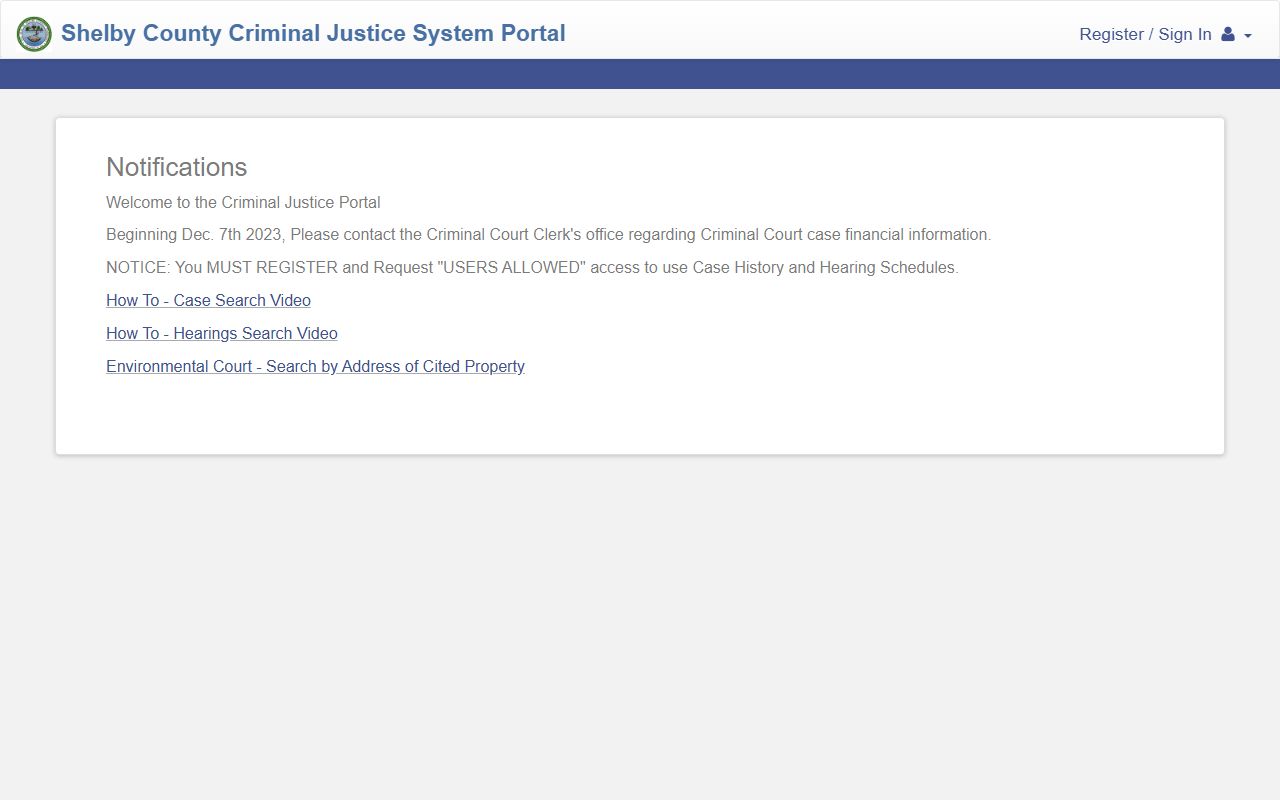
The CJS portal is the starting point for case-date lookups, case-number searches, and online payments for Shelby County Criminal Court cases.
Booking Number vs Case Number
A booking number and a case number are not the same thing. Understanding which one you have saves time when searching either the jail roster or the court system.
A booking number is assigned by the jail when a person is processed into custody. It ties to the physical detention record: the inmate profile, housing assignment, bond information, and detainer details. The Shelby County Inmate Lookup Tool searches by booking number directly, using the "Booking Number (PIN)" option in the identifier dropdown. The sample profile observed during research showed the booking number listed as one of the primary fields alongside Permanent ID and State ID.
A case number belongs to the court file created when charges are filed. In Shelby County Criminal Court, case numbers follow the format of eight characters, a dash, and eight more characters. If the case number starts with C, the CJS portal accepts it directly for payment. If not, the Criminal Court page says to use the indictment number together with the booking number. A single arrest can produce both a booking number at the jail and a separate case number at the court, so you may need both depending on what you want to look at.
- Booking Number (PIN)
- Assigned at jail intake. Used to search the inmate roster and pull the full detention profile including housing, bond, and detainer data.
- Permanent Number (PCP)
- A longer-term identifier for a person in the jail management system. Can also be used to search the inmate lookup tool.
- State ID (SID)
- Assigned by state law enforcement agencies. The inmate tool accepts this as a search identifier under the unique-identifier tab.
- Case Number
- Court-assigned identifier in the format of 8 characters, dash, 8 characters. Starts with C for some Criminal Court cases. Used in CJS and for court payments.
- Indictment Number
- Grand jury charging document number. Used in CJS payments when the case number does not begin with C, combined with the booking number.
Arrest Warrants in Shelby County
An arrest warrant is a court order directing law enforcement to take a person into custody. Warrants in Shelby County are searchable through the Sheriff's Warrant Information System, which is updated hourly. The warrant database is free and public but carries a clear warning: do not attempt to arrest or detain any subject listed. Only law enforcement may act on a warrant.
Warrant types that can appear in Shelby County records include arrest warrants issued on affidavit of complaint, bench warrants issued by a judge for failure to appear, and capias orders directing custody. A bench warrant is common when a defendant misses a court date. Once issued, it stays active until cleared by the court. Active warrants can affect bond eligibility and lead to additional charges in some situations.
If your name appears in the warrant system, the Sheriff's site says to contact the SCSO Fugitive Bureau at 222-5627. Transportation assistance to surrender can be arranged if needed. The full search field table and step-by-step instructions for resolving a warrant are on the Shelby County warrant records page.
Note: The warrant database is updated hourly, so a resolved warrant may still show briefly, and a recently issued warrant may not appear immediately.
Jail Booking and Inmate Profiles
When the Shelby County Sheriff's Office books someone into the jail, it creates an inmate record in the county's jail management system. That record is what feeds the public inmate lookup tool. The average daily census across the two adult facilities is approximately 2,600 inmates, with yearly bookings averaging 56,000 based on official jail page figures.
The Criminal Court Clerk directory lists division phone numbers for the Criminal Court, including a separate line for the Expungements division at (901) 222-3292.
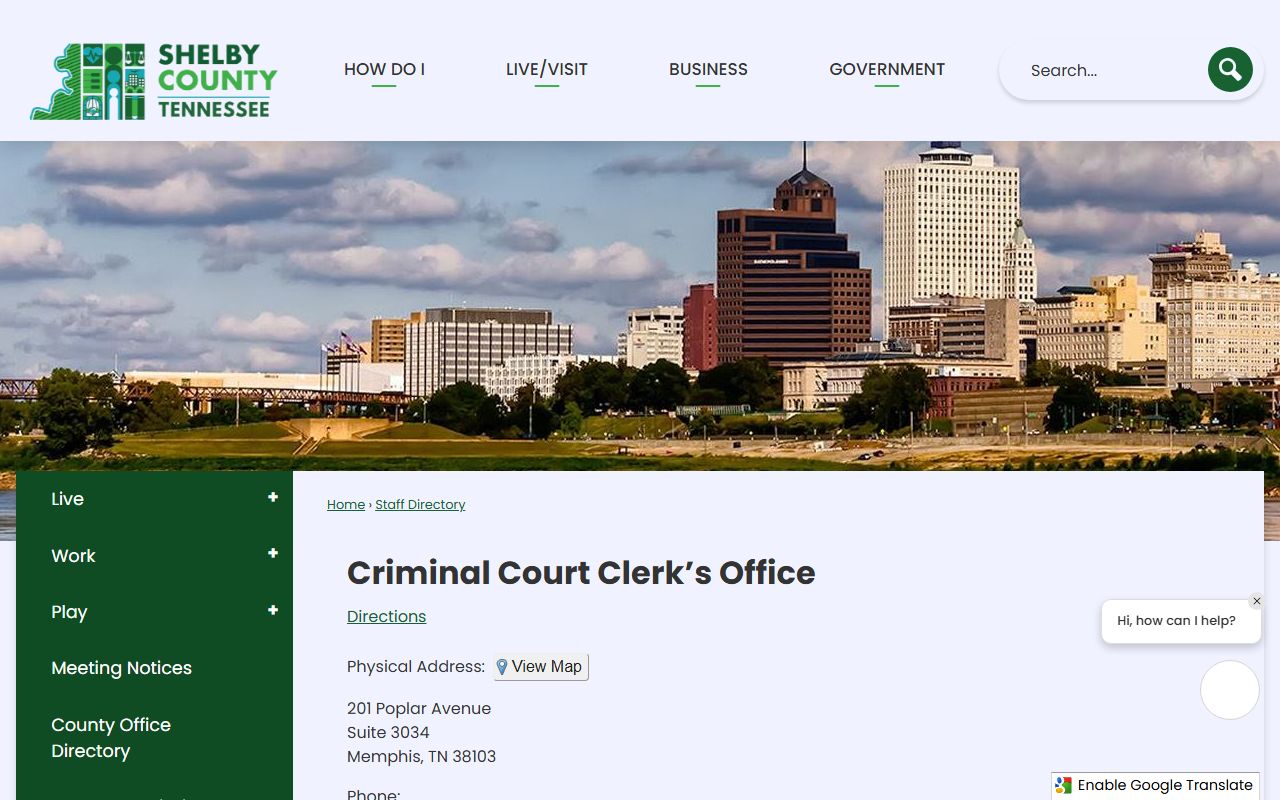
The Criminal Court Clerk directory is the place to call if you need to reach a specific division, from general case inquiries to the expungements line.
An inmate profile in the lookup tool shows considerably more than a name and booking date. The fields observed in a real profile during research include the following:
| Field | What It Shows |
|---|---|
| Name | Full name as entered at booking. |
| Sex / Race / Ethnicity | Demographic information from booking intake. |
| Date of Birth | Listed on the profile page. |
| Height / Weight | Physical description fields. |
| Hair Color / Length / Eye Color / Complexion | Physical description from intake. |
| Booking Number | PIN assigned at jail intake. |
| Permanent ID / State ID | Longer-term and state identifiers. |
| Marital Status / Citizenship / Country of Birth | Personal detail fields captured at intake. |
| Current Housing Section / Block / Cell / Bed | Where the inmate is physically located. |
| Commitment Date | Date the person entered custody. |
| Alias Information | Table of known aliases: last name, first name, middle name. |
| Detainer Information | Complaint number, date, issuing agency, set-by fields. |
| Bond Information | Case number, amount, bond type, status, posted by, post date, grand total. |
| Hearing Information | Upcoming hearing dates if any are scheduled. |
For a deeper look at the inmate lookup tool fields and search steps, see the Shelby County inmate records page.
Arrest Record vs Criminal Court Record
People often use these terms interchangeably, but they describe two different things created by two different offices. An arrest record documents the act of booking: who was taken into custody, when, and under what charges. A criminal court record documents the legal proceedings that follow when the state files formal charges. The two are related but separate files held by separate offices.
Full case history starting from indictment through plea, trial, and sentencing is in the criminal court file, not the jail record. For that level of detail, see Shelby County court records and the CJS portal or Criminal Court Clerk.
| Arrest Record | Criminal Court Record | |
|---|---|---|
| Who Creates It | Sheriff's Office / arresting agency | Criminal Court Clerk or General Sessions Clerk |
| When It Is Created | At booking, when the person enters custody | When charges are formally filed with the court |
| Primary Contents | Booking number, name, date, charges at arrest, bond, physical description, housing location | Affidavit of complaint, warrant, indictment, plea, motions, orders, sentencing, docket entries |
| Where to Search | Shelby County Inmate Lookup Tool at imljail.shelbycountytn.gov/IML | CJS portal at cjs.shelbycountytn.gov/CJS or Criminal Court Clerk at (901) 222-3200 |
| Mugshot / Photo | May be part of the booking record | Not typically shown in court file |
| Reflects Guilt | No. Shows arrest only, not outcome. | Shows charges, plea, and final disposition. |
Charges vs Convictions
Being charged with a crime is not the same as being convicted of one. This distinction matters when reading an arrest record or a criminal history. A charge means the state or a grand jury has formally accused a person of an offense. A conviction means a court has found or the person has admitted guilt, either through a verdict after trial or a guilty plea. Many people who are charged are never convicted, and an arrest record alone does not say how a case ended.
| Charge | Conviction | |
|---|---|---|
| What It Is | A formal accusation of a criminal offense | A finding of guilt after trial or a guilty plea accepted by the court |
| Standard Required | Probable cause (for arrest) or grand jury finding (for indictment) | Beyond a reasonable doubt at trial, or a voluntary knowing guilty plea |
| Who Decides | Law enforcement officer, magistrate, or grand jury | Judge or jury; or the defendant through a plea |
| Public Record | Yes in most cases; appears in arrest and booking records | Yes; appears in the court judgment and may affect background checks |
| Can It Be Expunged | Yes, if dismissed or no true bill; free expungement may be available | More limited; depends on T.C.A. § 40-32-101 eligibility |
Tennessee law, under T.C.A. § 40-32-101, governs when criminal records can be expunged. The Tennessee AOC says charges that were dismissed, returned as no true bill, resulted in a not-guilty verdict, or were entered as nolle prosequi may qualify for free expungement. Check the Tennessee AOC expungement page for current eligibility details before assuming any record can be removed.
Sealed vs Expunged Records in Shelby County
Sealing and expungement are two different legal remedies that limit public access to criminal records. Both reduce what a background check or court database search will show, but they work differently and have different eligibility rules under Tennessee law.
| Sealed | Expunged | |
|---|---|---|
| Effect on the Record | Hidden from public view; the record still exists | Destroyed or treated as if it never happened; erased in the eyes of the law |
| Who Can Still See It | Law enforcement and certain government agencies may still access sealed records | Very limited access even for law enforcement, depending on offense and statute |
| Common Triggers | Court order, protective order, or specific statutory category | Dismissed charges, no true bill, not-guilty verdict, nolle prosequi, certain qualifying convictions |
| Where to Apply | File a petition in the court that holds the record | File in the court of origin; General Sessions handles misdemeanor expungements; Juvenile Court Clerk has a separate expungements contact |
| Tennessee Statute | Tennessee Supreme Court Rule 34 governs what courts seal; T.C.A. § 10-7-504 covers confidential exceptions | T.C.A. § 40-32-101 is the main criminal expungement law; T.C.A. § 37-1-153 covers juvenile expunction |
In Shelby County, the Criminal Court Clerk's Expungements division can be reached at (901) 222-3292. General Sessions publishes its own expungements page for misdemeanor cases. The Juvenile Court Clerk at 616 Adams Avenue also handles juvenile record expungements through a separate contact process.
District Attorney and Public Defender Roles
Two offices play major roles in how criminal cases move through the Shelby County system. Knowing what each one does helps clarify what appears in arrest and criminal records.
The Shelby County District Attorney General, Steve Mulroy, leads the office that prosecutes people who violate Tennessee laws in Shelby County. The DA's office is organized into six vertical prosecution teams. Each team is paired with one General Sessions division and one Criminal Court division, and each team handles cases from first appearance all the way through to sentencing. The Domestic Violence Unit handles General Sessions Division 10 and Criminal Court Division 5.
The DA's site lists active news, the vertical team structure, and victim services, making it a useful reference for understanding how criminal prosecutions are organized in the county.
The vertical team structure means a case assigned to General Sessions Division 7 will stay with the same prosecutors when it moves to Criminal Court Division 1. This affects what court file the criminal record appears in and how consistent the case documentation will be from General Sessions through final disposition.
The Law Office of the Shelby County Public Defender provides representation to people who cannot afford private counsel. The office was established in 1917 and describes itself as the first public defender office east of the Mississippi. It represents clients in Criminal Court, General Sessions, Juvenile Court, and Circuit Court. State reimbursement accounts for approximately 97% of the Public Defender's budget. People who believe they may be eligible for appointed counsel should contact the office or raise the issue at their first court appearance.

The Public Defender's site includes an intake form for people who need help and an explanation of the office's services across all courts in the county.
Vertical Prosecution and Division Alignment
The DA's vertical prosecution model directly affects the structure of criminal records in Shelby County. Each team stays with a case from General Sessions through Criminal Court, so court files in both systems may be linked to the same prosecution team. The DA's vertical prosecution page describes the teams and their court division assignments.

The vertical prosecution structure means that a case record at General Sessions is handled by the same team that takes it through Criminal Court, creating a more consistent trail in the public case files.
The six teams are matched as follows: Team 1 covers General Sessions Division 7 (also Veterans Court) and Criminal Court Division 1. Team 2 covers General Sessions Division 9 (Mental Health Court) and Criminal Court Division 2. Team 3 covers General Sessions 11 and Criminal Court 3. Team 4 covers General Sessions 12 and Criminal Court 4. Team 5 covers General Sessions 13 and Criminal Court 9. Team 6 covers General Sessions 15 and Criminal Court 10. The Domestic Violence Unit sits across General Sessions 10 and Criminal Court 5. Knowing which division handled a case can help narrow a records search when only a partial case number is available.
Victim Notification
If a victim or family member needs to track the custody status of a person arrested or convicted in Shelby County, the DA's Victim/Witness Unit and the Tennessee Statewide Automated Victim Information and Notification system (TN SAVIN) are the main resources.
TN SAVIN is a toll-free inmate information and notification service. Victims can call (888) TNVINE1, which is (888) 868-4631, to check custody status of people in the Shelby County Jail. The VINELink platform connects to the same system online and allows victims and families to register for real-time notifications by text, email, phone, or app when a custody status changes. Registration is free and confidential.
The DA's Victim/Witness Unit can be reached at (901) 222-1300. Specialized coordinators are trained for homicide, sexual assault, elder abuse, domestic violence, gang cases, and Hispanic victims. The Juvenile Court Victim/Witness Coordinator, Jacob Ripberger, is available at (901) 222-0681 for cases in Juvenile Court. The Hispanic Victim/Witness Coordinator, Jacqueline Chacon, is at (901) 222-1432. These contacts can help victims stay informed as a case moves through the arrest, charging, and court disposition stages.